Operation redbud
Published 11:47 am Thursday, March 5, 2026
“There is something about planting trees that feels good. If you have done it well, it will outlast you and leave the world a little richer and more beautiful because of your efforts.” – James Rebanks “Pastoral Song: A Farmer’s Journey”
I spent a good portion of the day Sunday addressing a deficiency here at the farm. To be more specific, we have a tree deficiency. Some of you might find that hard to believe, especially since I’ve written before that we live on a certified tree farm.
We received the certification several years ago through the Mississippi Tree Farm Program which is affiliated with the American Tree Farm System. As soon as our forester let us know, I couldn’t wait to put up our green and white tree farm signs.
I’m sure you’ve noticed the signs at some point on woodlands in and around our state. They are a representation of sustainable forestry practices with the sign’s four sides — “Water, Wildlife, Recreation, and Wood” — laying out its core components.
For the most part, the trees that are “farmed” here are pines. However, we are also blessed with a few mixed hardwoods throughout as well.
We’re also blessed that our trees (timber sounds too much like a commodity to me) are healthy. Based on the recommendation of our forester we were able to complete a much needed thinning a few years ago, and it will soon be time for a prescribed burn.
Each of these activities ties directly back into the sustainability piece with each being beneficial for water, wildlife, recreation, and wood. So, with all these positive things going for us, what could possibly be deficient?
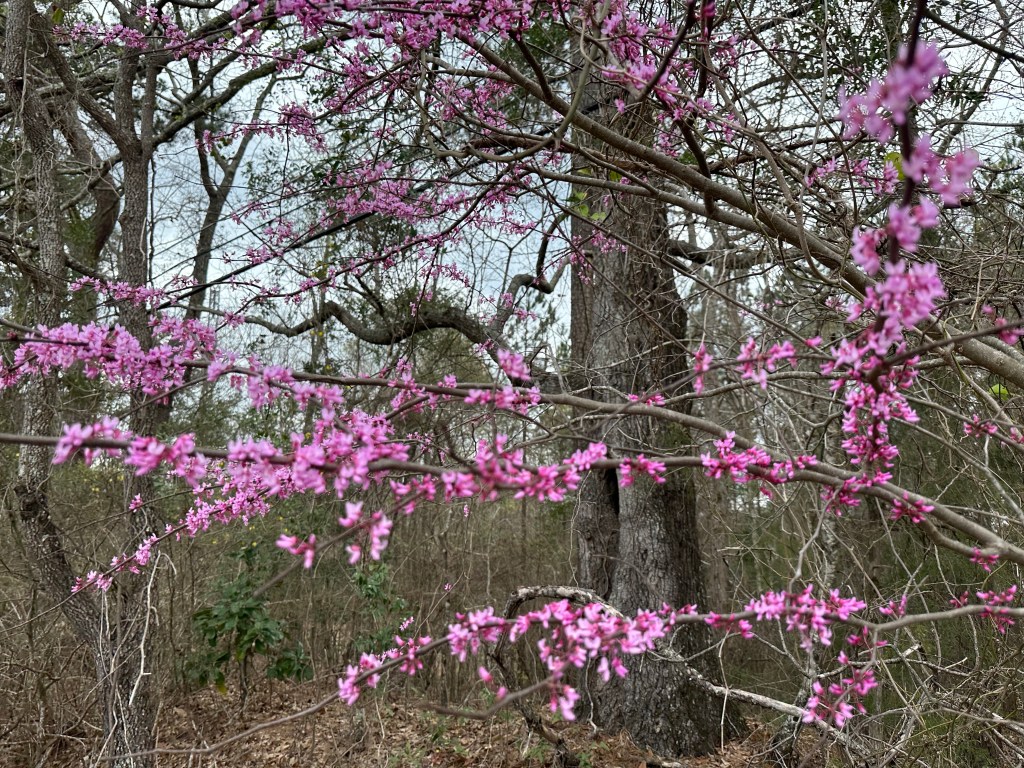
The simple answer is Eastern redbuds. When it comes to trees, I would find it hard to pick one favorite, however, if pressed to do so, the redbud would certainly be at or near the top of my list. Perhaps I would do better picking my favorite trees for each season.
In that case, the redbud would be my spring favorite. It is the harbinger of the coming spring, the first to pop out with its vibrant red buds and pink flowers against the drab backdrop of its leafless counterparts each having been stripped of their colorful ornaments by winter.
It is also the herald of my most favorite season—turkey season. There’s an old saying that goes something like this, “When the dogwoods bloom, the gobblers boom.” I would add redbuds to that saying as well.
Early last week while driving south for work, I saw my first redbud blooms of the spring. The sight put a smile on my face. It also got me thinking about the fact that we have very few redbuds here at that farm. More specifically, we have very few here around our house at the farm.
In fact, unless some have sprouted up since last year, unbeknownst to me, we have one. There are more throughout other parts of the farm, but here at home there is one lone redbud. Furthermore, I can’t even see it from our house. In order to see it, I must walk or drive to the end of our driveway.
One tree, especially when said tree is a personal favorite, certainly qualifies as a major deficiency in my book. As I made my way further south last week, enjoying the redbud explosion that was unfolding all around me, I realized that it was time to take matters into my own hands.
As I’ve written about often in the past, one of our goals after making the move to the farm was to begin restoring and incorporating more native plant species into our landscape.
The addition of Eastern redbuds, which are indigenous to eastern North America, ranging from southern Michigan all the way down to central Florida and west to southeastern Nebraska and eastern Texas, certainly checks the native box.
In addition to their aesthetic qualities (have I said that the buds and flowers are beautiful), the trees provide “early spring nectar for bees and butterflies, essential food and nesting sites for birds, improve air quality, and reduce erosion.
The flowers are edible, making a nice addition to salads in the spring. They can also be used for brewing “redbud tea,” a tart and delicate floral springtime beverage. Many Native American tribes also used the bark from the redbud to treat congestion and whooping cough.
Above all, I simply love to look at them, and, as I said, they make me smile. Driving along, I realized that it was time to remedy the redbud deficit here at our little farm on Brooksville Road. I was able to do that with just one text.
Actually, it required a little more than that. It was more like one text, a call, a shovel, and a little (a lot) of sweat equity. The text and call were to friend Jonathan Patterson.
Jonathan runs Wildlife Habitat Resources (www.wildlifehabitatresources.com or @wildlifehabitatresources on Instagram) in Florence which specializes in and is committed to “conserving and improving our native forests, wildlife, and wildlife habitat.”
As it turns out, great minds do think alike, as Jonathan had plans for planting redbuds around his property this past weekend as well. He also had plans to do a bit of work on his family land near Mashulaville which would make dropping off my trees both possible and convenient.
Forty holes and a little sweat later and we’re now up to 41 redbuds. When I finished, G asked how long it would be before we could expect beautiful pink blossoms along the wood line surrounding the house.
My answer—2 to 4 years—reminded me of the quote from James Rebanks that led this article. Rebanks goes on to say that “Planting a tree means you believe in and care about a world that will be there after you are gone.” Trees are an investment in the future. I like that.
Until next time, here’s to trees, here’s to playing the long game for the betterment of our environment, here’s to leaving a legacy for others to enjoy, here’s to companies like Wildlife Habitat Resources and people like Jonathan Patterson who share that vision, and here’s to seeing you out there in our great outdoors.