Getting to know our neighbors, the skunks
Published 4:50 am Saturday, January 31, 2026
Did I catch you off guard this cold January day? Our neighbors, the skunks, ah yes, there’s a lesson to be learned from our furry friends. You know it is true. Skunks have a place in our lives, perhaps not human or otherwise. But the way I see it is that we must accept them, and place value upon them, and it will make the difference. Read on as I introduce you to the mighty little skunk and his neighborhood village.
You see we neighbors know they are there (the skunks) somewhere near Windsor Drive. How do we know? Of course, by the overwhelming smell. Now it’s not a new habitat for the little fuzzy ones. Oh no, we’ve known them as neighbors for several years, known them by the scent, that is. We will sort of forget them for weeks and weeks and then it happens – that odor is at the same place over and over, week by week, year by year. Yes, these skunks are survivors. I decided I should know more about my neighbors.
Over the years, I caught quick glances of the black/white mammals; however a quick glance not because the skunk was moving fast. I was the one on the move, uh-huh. How could I get to know them, if I’m always in the avoiding mode? I’m still working that out, but in the meantime, here are some great skunk facts (now stay with me on this). I mean how often does a skunk primer come your way?
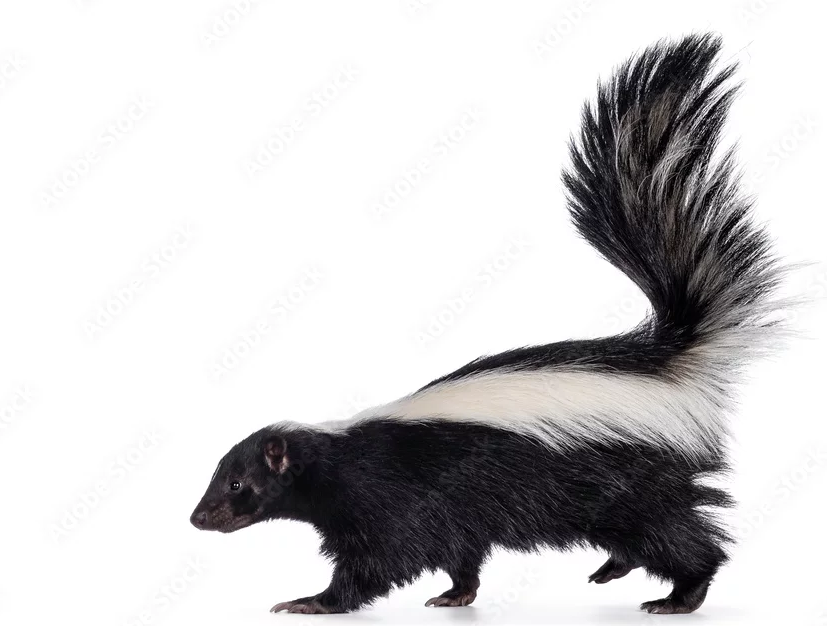
I have to admit the little fuzzy ones are cute, sort of like a cat. They are the same size as a small housecat – 22 to 26 inches in length and weighing 3 to 12 pounds. They have small pointed faces and bushy tails. Their most distinguishable characteristic is the two white stripes extending down the back from a patch of white fur on the top of the head. They have five toes on each foot, and the front feet possess long claws for digging. Their tracks are similar to cat tracks; however cats only have four toes. Skunks can accurately direct the spray of their musk up to 10 feet – first stamping their front feet and then raising the tail.
Their habitat is all around us, the humans. The skunks will use anything handy for homes, like stumps or old buildings The babies are born in May or early June. In the fall, the young skunks leave the den to find their own homes. They hunt at night and sleep during the day. Skunks prefer to eat insects, crickets, or berries other vegetation. Sometimes they will eat bird or snake eggs, and if handy, they will eat CAT FOOD!
Yep, my few encounters with the neighborhood skunks have been on my porch while they munched down on Purina Cat Food. George and Gracie, our two white, rescue kitties, stood respectively to the side (many feet to the side) until the deed was done. Yes, I was smart enough not to scare it – just let the skunk eat and leave. Later I moved the food bowls and there have not been any recent neighborly visits, not that I know about, that is.
So all of these skunk facts are rolling around in my head this week. I mean how the critters have survived for years especially in the one spot. Oh, I know the present ones are descendants, but still it’s remarkable. Skunks are survivors. There’s a lesson to be learned, and maybe it is not all just about the smell.
Skunks have many life-threatening enemies: dogs, foxes, coyotes, humans, automobiles, and disease such as rabies. Yet, the skunk family, according to experts, is not endangered. It’s more than the skunk habitat, lifestyle, or even heritage. Their survival must be inside their brains. Yes, Skunks are Smart! Hmm …
I’m on to something here!
As I researched, my inclination was to turn to my storytelling sources. Stories passed down through the generations that teach survival and life lessons. I turned to a collection of stories by the Indigenous Peoples’ Literature group entitled, “Skunk Outwits Coyote.” The short story describes now the skunk outwitted a neighborhood coyote because the skunk talked him into tying a large stone to his leg. Go figure!
Skunk is smart, for sure.
Recently I found another story entitled, “The Sweet Smelling Skunk” by Artie Knapp. A really cute little story about an elderly lady and her veggie garden and how she hired the skunk to help keep all of the neighborhood nibblers, such as deer and rabbit, out of her turnip green patch. The little skunk was disappointed to think that she wanted him to use his bad smell, but instead she had him sing. It all worked out and the lady and the skunk became the best of friends.
What is the lesson learned?
The neighborhood skunk maintained his habitat regardless of possible problems. Nothing is perfect – make your home, your home.
He stayed true to family, offered his support and in return asked for help when needed.
He played his “trump card” (bad small) only when necessary as a last resort.
He outsmarted a dangerous enemy.
He made friends and discovered new talents.
Who would have thought – Smart Skunk? If the smell doesn’t “get you” then the smartness will.
Anne McKee is a Mississippi-inspired storyteller. See her website annemckeestoryteller.com