Hunting the wind
Published 10:00 am Thursday, January 29, 2026
“You don’t need a weatherman to know which way the wind blows.” – Bob Dylan, “Subterranean Homesick Blues”
For a hunter, I don’t know if there’s a feeling any worse than that of getting winded by a deer. Actually, I take that back. Getting busted by a gobbler that you’ve managed to call your way or getting too close in the darkness of early morning and “bumping” or spooking a longbeard from his roost would come in first for me.
Getting winded by a deer, especially a wise old buck that you’ve been hunting all season, would then come in at a close second for me. In either scenario, avian or cervid, I always get a sick feeling in my stomach as I ponder where exactly I went wrong.
Years ago, when I first started deer hunting, I was given some sage advice by one of the “old-timers” at our annual hunting club picnic. “If you want to kill a good buck,” he said, as he poured a line of tobacco from a can of Prince Albert onto a rolling paper, “you need to learn to hunt the wind.”
I had been to the grizzled hunter’s farm before and I immediately remembered the numerous sets of large antlers that covered the outside wall of his barn. He knew what he was talking about.
On the ride home that day, I grilled my dad about the old hunter and exactly what it meant to hunt the wind. This was a time long before the arrival of scent killing sprays, scent blocking clothes, and products like scent-eliminating “ozone generators” (yes, that’s a thing).
These days scent-elimination is a big part of the hunting “industry.” Attend any hunting trade show that includes hunting for whitetails, and you’ll see what I mean. A quick Google search will tell you that the scent elimination and attractant market generates $350 to $450 million annually. It’s big business.
Personally, I use no-scent body wash as well as some type of scent-eliminating laundry detergent for my hunting clothes. I’ve also used scent-eliminating spray for my hunting boots over the years, and I’ve certainly used attractants like “doe-in-heat.”
While I don’t swear by any of these products (other than the body wash and laundry detergent) and I don’t claim any particular brand loyalty, I felt it necessary to have a bit of full disclosure.
I’ve bought into the “scent-killer” hype, at least to some degree. However, I do not own an “ozone generator” (you must draw the line somewhere).
That said, how did hunters kill deer in the days prior to the arrival of these scent-arresting products? Furthermore, how is it that a man known to smoke hand-rolled cigarettes while deer hunting (both still hunting and hunting from blinds) managed to kill a barn wall full of trophy whitetails?
The simple answer is that he heeded his own advice. He hunted the wind. He was also an excellent woodsman, a good shot, and one of the most diligent pre-season scouters in the club.
When the season arrived, he had done his scouting homework. He knew where the deer were, and he knew the best places to position himself (based on wind direction) to allow for the highest probability of seeing a big buck. In other words, he was in the right place at the right time almost every time because he had done the recon.
A lot has changed since those days. Cellular game cameras take a lot of the work out of preseason scouting. Simply put, these cameras can be there when you’re not, and the information they provide in real time can give you a big advantage.
That said, there’s no substitute for boots on the ground. Scouting can give you the lay of the land and can help you determine where to place stands or blinds or what areas to still hunt that will give you the best chance to hang a trophy buck on the wall.
Preseason scouting can also give you a better idea of where to hunt based on prevailing winds. For each of my established stands here at the farm, I have a setup that allows for the best chance of success based on wind direction. The seasoned hunter’s advice to “hunt the wind” has been the one thing that I would point to over the years that has yielded the most success in the whitetail woods.
Hunting the wind works, at least it works when you stick to your guns and do it. Unfortunately, the opposite is also true, a fact that I was reminded of this past Saturday morning.
I had been waiting for the wind to be right to hunt a spot here at the farm that was being frequented by a nice buck. Saturday morning with the coming ice storm set to roll in, I had a wind that was, at best, marginal. Nonetheless, I convinced myself it would work as I was bound and determined to hunt that spot.
Settling in well before first light, I checked the wind direction. At that hour the wind was fine, but my weather app told me that it would be shifting directions over the next few hours. “This will work,” I told myself as I settled in for the hunt.
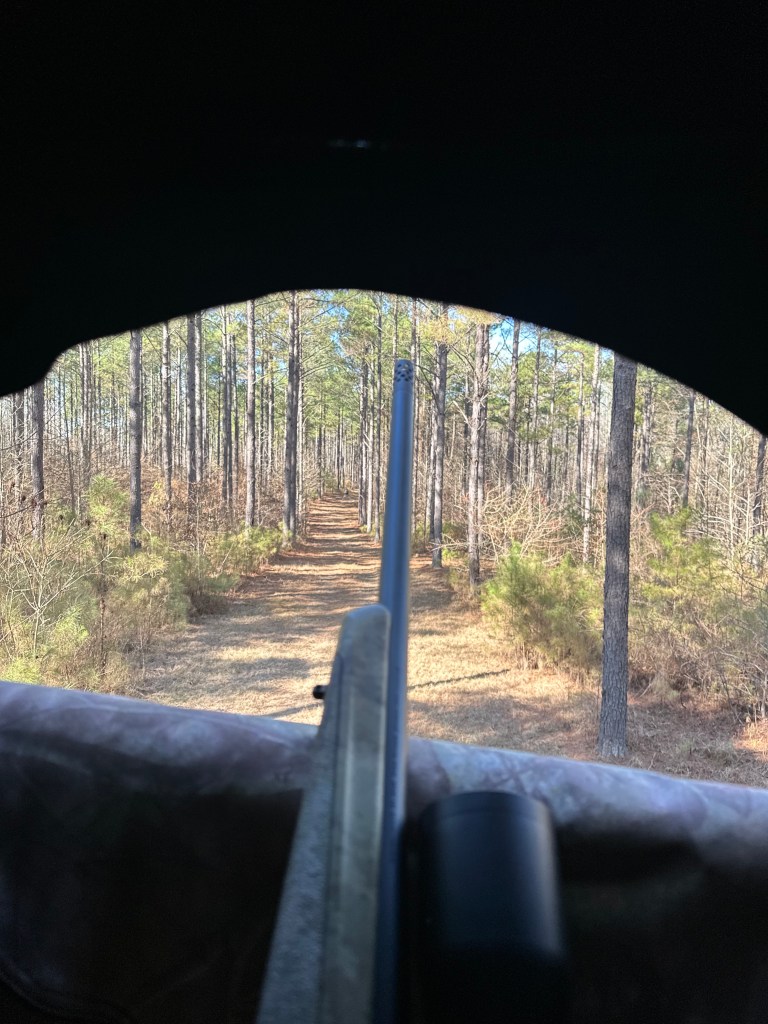
In the gloaming, I checked the wind again and noticed that it had shifted ever so slightly. “You’ll be ok. You’re in a blind and he’s been coming from the back of the food plot,” I told myself as I sat there, rifle at the ready.
When a doe and yearling walked out about an hour later, they looked nervous. She checked the wind two or three times before turning, throwing up her tail, and heading in the opposite direction. When she stopped at the wood line, I knew what was coming.
I feel quite certain that the loud whooshing of her alarm signal, her blowing at me, could be heard well into the next county. I also had no doubt that my hunt was over. As I walked back down the hill with my tail tucked between my legs, I mouthed the old man’s words in a whisper.
“Hunt the wind,” I said. It’s great advice, especially when you take it.
Until next time, here’s to the days in the woods that keep us humble, here’s to great advice given from veteran hunters (even when you choose not to heed it), and here’s to seeing you out there in our great outdoors.